From Clay to Memory: Cuneiform in the Terra Sancta Museum

Few inventions have transformed human history as profoundly as writing. The earliest known writing system, cuneiform, emerged in southern Mesopotamia around 3200 BC and revolutionized the way people recorded information, communicated ideas, and preserved knowledge. Initially developed to manage economic and administrative affairs, it soon became the medium for literature, religion, law, science, and royal inscriptions. For more than three millennia, cuneiform remained the principal writing system of Mesopotamia and much of the ancient Near East, adapting to different languages and cultures while reflecting the political and cultural history of the region.
Why was writing invented?
The origins of cuneiform are closely linked to the rise of the first cities in southern Mesopotamia, especially Uruk. During the Uruk period (ca. 3500-3100 BC), expanding trade, centralized temple institutions, and increasingly complex administration created the need for reliable systems of record keeping. At first, officials used small clay tokens and impressed markings to represent goods and quantities. As economic life became more sophisticated, these accounting devices gradually evolved into pictographic signs inscribed directly onto clay tablets.
Over time, scribes abandoned drawing curved images and instead pressed the cut end of a reed stylus into soft clay, producing the distinctive wedge-shaped impressions that gave cuneiform its characteristic appearance. The signs gradually became more abstract and acquired phonetic values alongside their original pictorial meanings, allowing scribes to record not only commodities but also names, grammar, and increasingly complex texts. By the beginning of the Early Dynastic period (ca. 2900 BC), cuneiform had become a fully developed writing system.
Why is it called cuneiform?
The word cuneiform derives from the Latin cuneus, “wedge”, and refers to the distinctive wedge-shaped impressions produced by pressing a reed stylus into wet clay. Unlike alphabetic scripts, cuneiform consisted of hundreds of signs that could represent either whole words (logograms) or syllables (phonetic signs). This flexibility enabled scribes to write an extraordinary variety of texts, from administrative records and legal documents to literature, mathematics, astronomy, and religious compositions.
Why did Mesopotamians write on clay?
Clay was the ideal writing material in Mesopotamia. Fine alluvial clay from the Tigris and Euphrates river valleys was abundant, while suitable stone and timber were relatively scarce. Tablets were shaped while moist, their surfaces smoothed, and inscriptions made with a reed stylus. Everyday documents were usually dried in the sun, whereas important texts were fired in kilns to ensure their long-term preservation.
The same material used to build houses, temples, and city walls also preserved contracts, letters, literary works, and scientific knowledge. Thanks to the remarkable durability of baked clay, tens of thousands of cuneiform tablets have survived, providing an unparalleled record of ancient Mesopotamian civilization.
Was cuneiform only a tool for keeping accounts?
Although cuneiform originated as an administrative tool, it quickly became far more than a system for recording economic transactions. Kings commemorated military victories and monumental building projects; priests recorded hymns and rituals; scribes copied literary masterpieces such as the Epic of Gilgamesh, and scholars documented advances in mathematics, astronomy, medicine, and lexicography.
For over three thousand years, cuneiform served as the principal vehicle for preserving the history, literature, religion, and scientific knowledge of Mesopotamia. More than a writing system, it became the intellectual foundation of one of the world’s earliest civilizations, influencing neighbouring cultures across Anatolia, Syria, Iran, and the eastern Mediterranean.
What existed before writing?
Before writing was invented, Mesopotamian administrators recorded commodities such as grain, livestock, oil, and textiles using small clay tokens of different shapes. The tokens were often sealed inside clay envelopes (bullae), whose outer surfaces carried impressions indicating their contents.
As administration became increasingly complex, scribes began impressing symbols directly onto flat clay tablets instead of enclosing tokens within bullae. This simple but revolutionary innovation marked the transition from three-dimensional accounting devices to true written records, paving the way for the invention of writing.
Why did cuneiform last for more than three millennia?
One of cuneiform’s greatest strengths was its remarkable adaptability. Originally developed for Sumerian, it was later adopted to write many other languages, including Akkadian, Babylonian, Assyrian, Elamite, Hurrian, Hittite, Urartian, and Old Persian. This flexibility, together with the prestige of Mesopotamian scribal traditions, allowed cuneiform to spread throughout the ancient Near East and remain in continuous use for more than 3,000 years.
From its beginnings around 3200 BC until its gradual disappearance during the first centuries CE, cuneiform witnessed the rise and fall of kingdoms and empires, making it one of the longest-lasting writing traditions in human history.
The Museum Collection
The voices of ancient Mesopotamia have travelled across thousands of years and hundreds of kilometres to reach Jerusalem. Preserved in clay, stone, and precious materials, the objects displayed in the Museum, including clay tablets and bricks, allow us to encounter the people who created, used, and entrusted their memories to writing.
Tablets from Umma
Dating to the Third Dynasty of Ur (2100-2000 BC), these administrative tablets are written in Sumerian and record the management of agricultural resources. They document irrigation works, as well as the distribution of essential commodities such as beer, barley, and flour, illustrating the highly organized economy of the Ur III state.
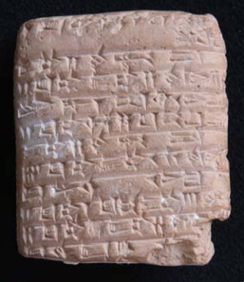
Tablet from Drehem
This Neo-Sumerian administrative tablet dates to the reign of Amar-Sin (2046-2038 BC), the third ruler of the Third Dynasty of Ur. Originating from the economic archive of Drehem (ancient Puzrish-Dagan), it records the redistribution of livestock, reflecting the centralized administration of agricultural production and state resources.
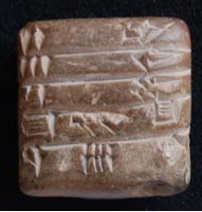
Brick of Amar-Sin
Inscribed in Neo-Sumerian, this foundation brick bears a dedication by King Amar-Sin (2046-2038 BC), the third ruler of the Third Dynasty of Ur. The inscription celebrates the king’s patronage of the Temple of Enlil at Nippur, emphasizing his role in maintaining and restoring one of Mesopotamia’s most revered religious centres. Such inscriptions reinforced royal legitimacy by linking the king with the protection and renewal of sacred institutions.
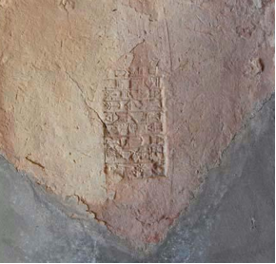
Tablets from Uruk
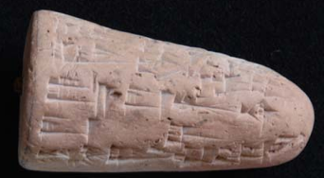
These Sumerian inscriptions date to the reign of Sin-Kashid (1865-1833 BC), the first Babylonian ruler of Uruk. They commemorate the construction of his royal palace and the restoration of the Eanna Temple, the city’s principal sanctuary dedicated to the goddess Inanna (Ishtar), highlighting the close relationship between kingship, architecture, and religious devotion. One of them is a “foundation nail”: the nail-shaped form deliberately echoed the wooden pegs used by surveyors to measure land and trace the plans of buildings on the ground. Transforming this practical tool into fired clay and inscribing it served to “fix” magically and for eternity the boundaries of the god’s and the king’s property, like palaces and temples, protecting them against any future claims or disputes.
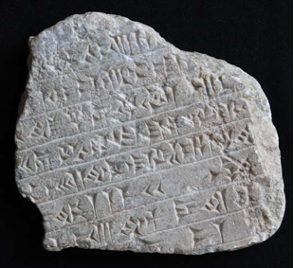
Tablet of Assurnasirpal II
This tablet preserves a fragment of the “Standard Inscription” of Assurnasirpal II (883-859 BC), written in Akkadian cuneiform. The text formed part of the decorative program of the king’s palace at Kalhu (Nimrud), where it was repeatedly inscribed to commemorate his military victories, building projects, and royal achievements. Such inscriptions proclaimed the king’s authority while preserving his legacy for future generations.
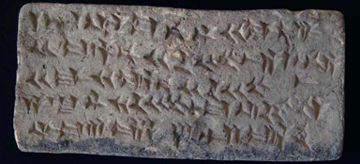
Brick of Shalmaneser III
Inscribed in Akkadian, this foundation brick dates to the reign of Shalmaneser III (858-824 BC). It records the king’s completion of the ziggurat at Kalhu (Calah), a monumental project begun by his father, Assurnasirpal II. Foundation inscriptions such as this were embedded within buildings to commemorate royal patronage and ensure the enduring memory of the ruler’s accomplishments.
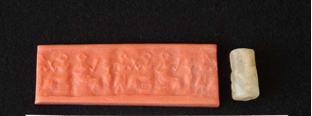
Cylinder Seals
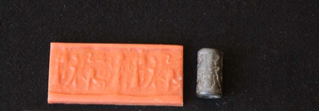
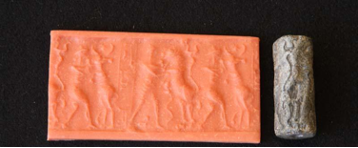
Spanning from the Ur Dynasty (2500-2000 BC) to the Neo-Assyrian period (932-612 BC), the cylinder seals of the Museum are carved from a variety of materials, including hard stone, white chalcedony, hematite, syenite, and blue glazed frit. When rolled across wet clay, they produced detailed impressions that served as signatures, administrative markers, and symbols of identity and authority.
Jihad Hamoudeh, an archaeologist who graduated from the University of Bethlehem in 2025, began his journey with an internship at the SBF Archeological Museum. He now works as a Museum and Education Assistant.
He divides his time between the museum and the Hekayat Turath team, where he is responsible for educational activities and workshops. He also contributed to the development of part of the museum section that will open this autumn, including the cuneiform tablets.