The Archaeology of Memories
In the maps of memory and among the stones of ancient Jerusalem lie stories at risk of fading away, swallowed by time and urban transformations. This is precisely where the research of Noor Abu Khdeir begins -a Palestinian scholar who grew up in the alleyways of the Old City and is currently pursuing a PhD at Paris 1 Panthéon-Sorbonne University.
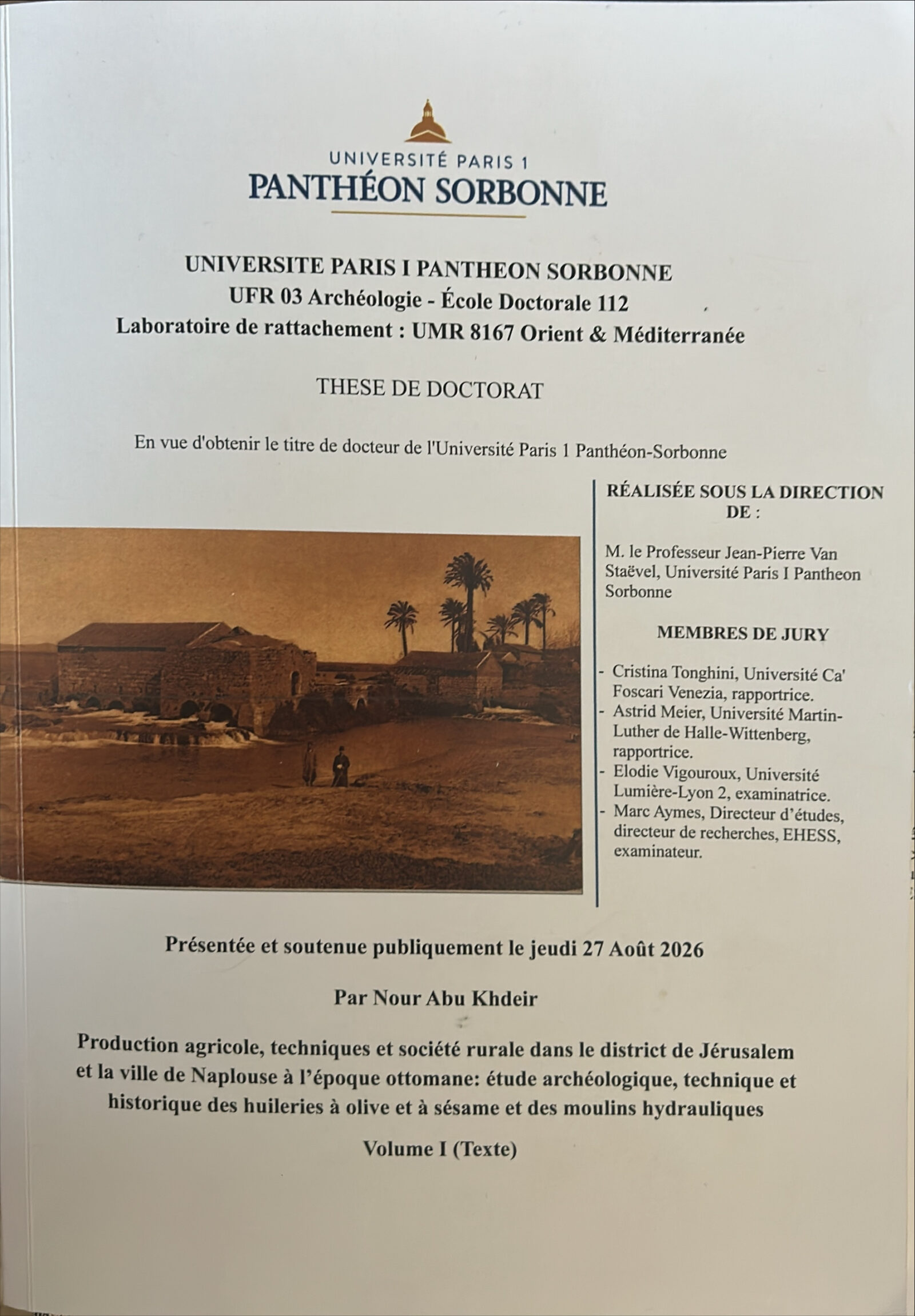
Hers is not merely an academic endeavor, but a true work of historical and identity reconstruction. At the center of her work lies agricultural production and rural society in Palestine during the Ottoman period: an investigation spanning the villages of Nablus and the district of Jerusalem, analyzing ancient oil presses and water mills.
“Mine is a technical, heritage, and archaeological study,” Noor explains. “My job is to create a bridge between the Ottoman archives and those of the British Mandate. When a building no longer exists in today’s reality, we use the archives to reconstruct it, to prove its presence, and to understand where it was located exactly.”
The mystery of sesame and the urgency of olive oil
The archives reveal unexpected social and economic dynamics. On the trail of craft guild registers, Noor discovered, for instance, how sesame oil production was exclusively urban, unlike olive oil, which was deeply tied to the rural life of the villages.
“The registers show that sesame oil disappeared from the countryside; it was processed almost exclusively within the Old City of Jerusalem,” she recounts. “It is a matter of logic: sesame was not as abundant as olives. With olive oil production, however, there was an immediate urgency to press the harvest on-site, and it was too difficult to transport huge quantities of olives from the villages into the city.”
While the registers tell us what was produced, it is the maps and highly detailed administrative reports of the British Mandate that restore the exact shape of that vanished landscape.
A chance encounter and the role of the Custody
As often happens in research, the most fascinating discoveries arise from unexpected encounters. While visiting a friend employed at Terra Sancta Museum, Noor stumbled upon a fragment of history that reignited her curiosity: traces of Jerusalem’s early steam mills, vaguely mentioned in some studies but never definitively located.
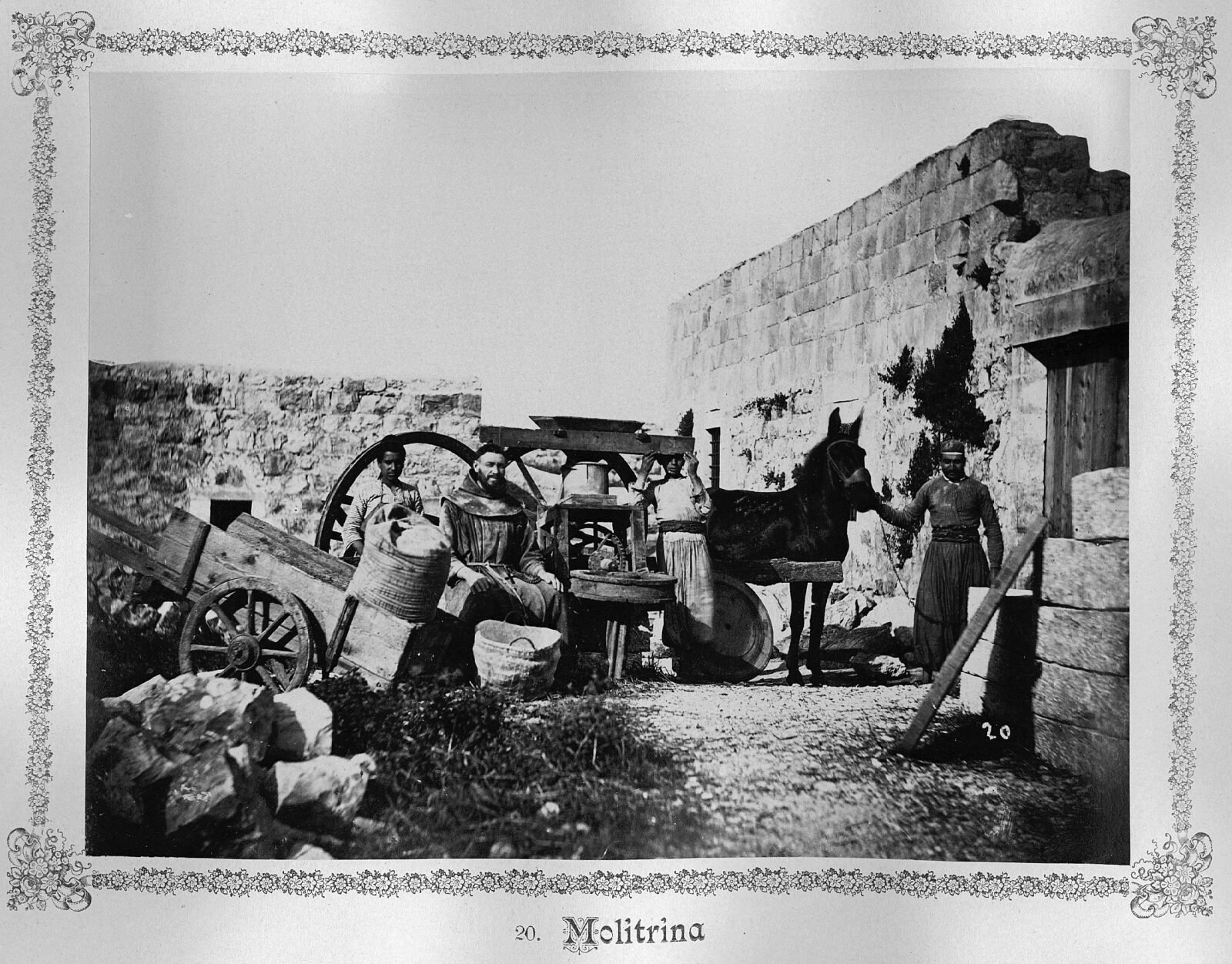
Guided by Father Stéphane, who welcomed her warmly from the very start, Noor was able to explore the spaces and consult materials preserved in their archives. There, she discovered old cellars with Ottoman-era wine presses and, above all, a rare and precious photograph.
“In my dissertation, I included the grain mills (not the wine presses, which I kept out of this work). It was essential to mention them because they represent a very rare testimony to the use of steam mills in the city at the end of the Ottoman period.
Since there are no detailed textual descriptions in existing sources, the documentation relies essentially on this single photograph preserved in the Custody archives, provided to me by Father Stéphane. I described the photograph, which shows the mill located inside the complex and a group of local workers employed by the facility. Even though there was no time to delve into every single detail -which would require extensive archival excavation that I hope to undertake in the future- it was important to provide this context and document this testimony.”
That single image captured the mill situated within the complex and a group of local workers engaged in grinding grain -a crucial detail demonstrating the deep bond and economic impact religious institutions had on the surrounding urban community.
Today, as she awaits her PhD defense, Noor’s journey also enriches the mission of the Terra Sancta Museum. Preserving the memory of Jerusalem means bringing stories like this back to light, proving how the Franciscan Custody was a living, open, and deeply integrated part of the city’s daily life.